There’s a quiet frustration running through a lot of small law firms right now.
They’re publishing content. They’re paying an agency. They have a decent-looking website. And yet the phone isn’t ringing the way it should. Leads are inconsistent. Growth feels unpredictable.
The problem usually isn’t effort. It’s direction.
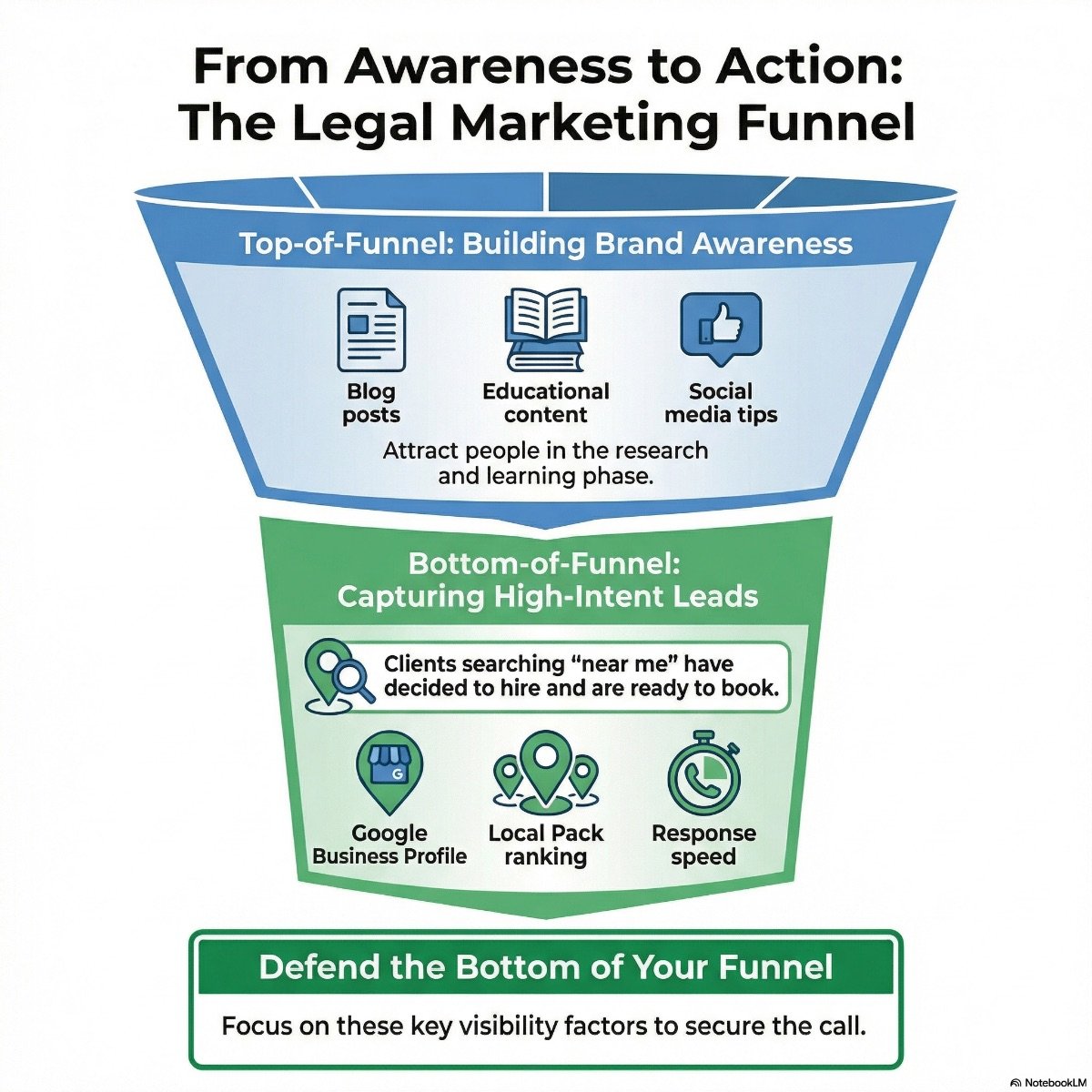
Most law firm marketing is built around the top of the funnel, the awareness stage, where potential clients are researching, learning, and comparing options. Blog posts, educational articles, social media content, these tools serve people who are early in their decision process. They’re useful. They build credibility over time.
But they’re not where clients get won.
Where the Decision Actually Gets Made
Think about what happens when someone actually needs an estate planning attorney.
It rarely starts with a Google search for “what is a living trust.” More often, it starts with a life event, a parent’s diagnosis, a new grandchild, a conversation with a friend who just went through probate. Something shifts, and suddenly they’re not researching anymore. They’ve already decided they need help. Now they’re looking for who to call.
They open Google. They type “estate planning attorney near me.” And they look at the map.
Three firms appear. They scan the names, check the reviews, and call the one that looks most credible and accessible. That entire process, from search to dial, can take less than four minutes.
This is the bottom of the funnel. And for most small law firms, it’s almost completely undefended.
The Funnel Disconnect
Top-of-funnel marketing and bottom-of-funnel visibility are two different problems that require two different approaches.
A blog post about “five things to consider before creating a will” serves someone who is months away from hiring anyone. It builds ambient awareness. It earns trust slowly. That has real value, but only if your firm also shows up when that same person is ready to act.
The Google Local Pack is where that readiness gets captured. Those top three map results aren’t just a visibility tool. They’re a transactional engine. The people clicking on those results aren’t browsing. They’re buying.
The data backs this up. Roughly 42% of local searchers click exclusively within the map results. Nearly 68% of legal clients make their first contact by phone. And 42% hire the first attorney they actually speak with.
That means the race isn’t just about being visible. It’s about being first, and being reachable when someone is ready right now.
Where Most Agencies Get It Wrong
The default agency playbook is built around metrics that feel meaningful but don’t always connect to calls. Traffic. Domain authority. Content volume. Backlink counts.
These metrics have their place. But for a solo practitioner or small firm trying to grow in a specific city, they often describe activity at the wrong end of the funnel.
A firm can rank on page one for a broad informational keyword and still not appear in the Local Pack for the transactional searches that actually drive consultations. These are different ranking systems with different signals, and most agencies treat them as the same problem.
They’re not.
What Bottom-of-Funnel Visibility Actually Requires
Getting into Google’s Local Pack, and staying there, comes down to a specific kind of structure.
Your Google Business Profile needs to be fully built out, not just claimed. That means complete service listings, consistent photos, regular posts, and a steady flow of reviews. It means your business name, address, and phone number are identical everywhere they appear online.
Your website needs to support that profile, not operate independently of it. Each service your firm offers should have its own dedicated page. Your homepage should immediately tell Google your primary practice area and the city you serve. The internal architecture of your site should mirror the structure of your Google Business Profile so that every signal points in the same direction.
When those two things align, Google gains confidence. And confident Google shows your firm to people who are ready to hire.
The Practical Question
Most small firms don’t need more content before they need more calls. They need to fix the bottom of the funnel first, capture the demand that already exists, and then build the content layer that feeds long-term awareness on top of it.
Doing it in the wrong order is a common and expensive mistake.
Ask yourself honestly: when someone in your city searches for the specific service you offer, does your firm appear in the top three map results? If the answer is no, or if you’re not sure, that’s where the work starts.
The blog posts can wait. The Local Pack cannot.